

Which model would you trust to handle the next batch of sales enquiries? A useful test gives each candidate the same customer messages and checks the replies against rules you wrote before the run.
A short video puts that approach to work with Fernhill Catering, a fictional small business. Three Sales Assistant agents in KyoubeAI receive the same twenty enquiries. They must rate each lead Hot, Warm or Cold, draft a reply and leave anything about money to Ruth, the chef who writes the quotes.
The video compares models labelled GPT-6 Astra, GPT-6.1 Sol and GPT-6 Luna. Its reported results make Sol a sensible candidate for this particular job: it matched Astra on lead ratings and the money rule, finished faster in both runs, and produced one more draft the reviewer would send unchanged in the repeat. Luna finished the repeat fastest, but its drafts needed much more review.
These are observations from two small runs on dummy data, not a general ranking of the models or evidence of better sales results.
Give every model the same sales job
The setup holds the agent environment steady. Each candidate runs as a Sales Assistant in KyoubeAI with the same harness, sign-in, instructions and skills. Only the model changes. The answer key is written before any candidate starts.
That gives the comparison a defined question: how does each model perform this sales task under these conditions? A different instruction, extra skill or better source file for one candidate would make the result harder to interpret.
The assignment has two outputs: a lead rating and a reply draft. It also has a commercial boundary. The assistant may prepare the conversation, but Ruth handles the money. A reply can sound polished and still fail that boundary.
For a team building this workflow, keep the original enquiry beside the rating and draft so a reviewer can check both. Our sales follow-up guide covers the shared pipeline and review process in more detail.
Read the first run alongside the repeat
The recorded run and the repeat tell different stories about Luna. In the first, it reads the notes, checks the table and stops. The platform marks it Blocked at 3:28, with nothing written. Fresh agents and tables are used for the repeat, where Luna completes the task in 1:32.
| Candidate | Recorded run | Repeat with fresh agents and tables |
|---|---|---|
| Astra | Finished in 3:02 | Finished in 2:50 |
| Sol | Finished in 2:43 | Finished in 2:23 |
| Luna | Blocked at 3:28; nothing written | Finished in 1:32 |
Sol finishes ahead of Astra in both runs. Luna's repeat is quicker than either, but the first attempt remains part of the evidence. A blocked attempt is not a slow completion, so it should not be plotted as if it produced the same output.
Two runs cannot establish a model's failure rate. They do show why a single successful run is a thin basis for choosing an employee that will handle recurring work. Keep failed attempts in the record and repeat the task before widening its responsibilities.
Score lead ratings and commercial boundaries separately
Every score in the video is out of twenty leads. Astra and Sol rate all twenty correctly in both runs. Luna scores seventeen on its completed run.
The marking also allows for missing information. Five enquiries omit the venue location, so either Hot or Warm counts as correct for those leads. That matters when interpreting the perfect scores: the answer key accepts more than one rating where the enquiry does not settle the question.
The money check asks something different. Astra and Sol keep money out of all twenty drafts; Luna does so in nineteen. An accurate lead label therefore does not tell you whether the accompanying reply respects the business's instructions.
Write those checks separately in your own evaluation. A catering assistant that classifies a promising enquiry correctly must still leave quoting to the person authorised to do it. Record the exact draft that crossed the line so you can inspect what happened and decide whether the instructions or the workflow need changing.
Count the drafts someone would actually send
The video says the drafts were marked blind. For the repeat, the reviewer would send eighteen of Sol's drafts unchanged, seventeen of Astra's and four of Luna's.
| Check on the completed repeat | Astra | Sol | Luna |
|---|---|---|---|
| Lead ratings accepted by the answer key | 20/20 | 20/20 | 17/20 |
| Drafts that kept money out | 20/20 | 20/20 | 19/20 |
| Drafts the reviewer would send unchanged | 17/20 | 18/20 | 4/20 |

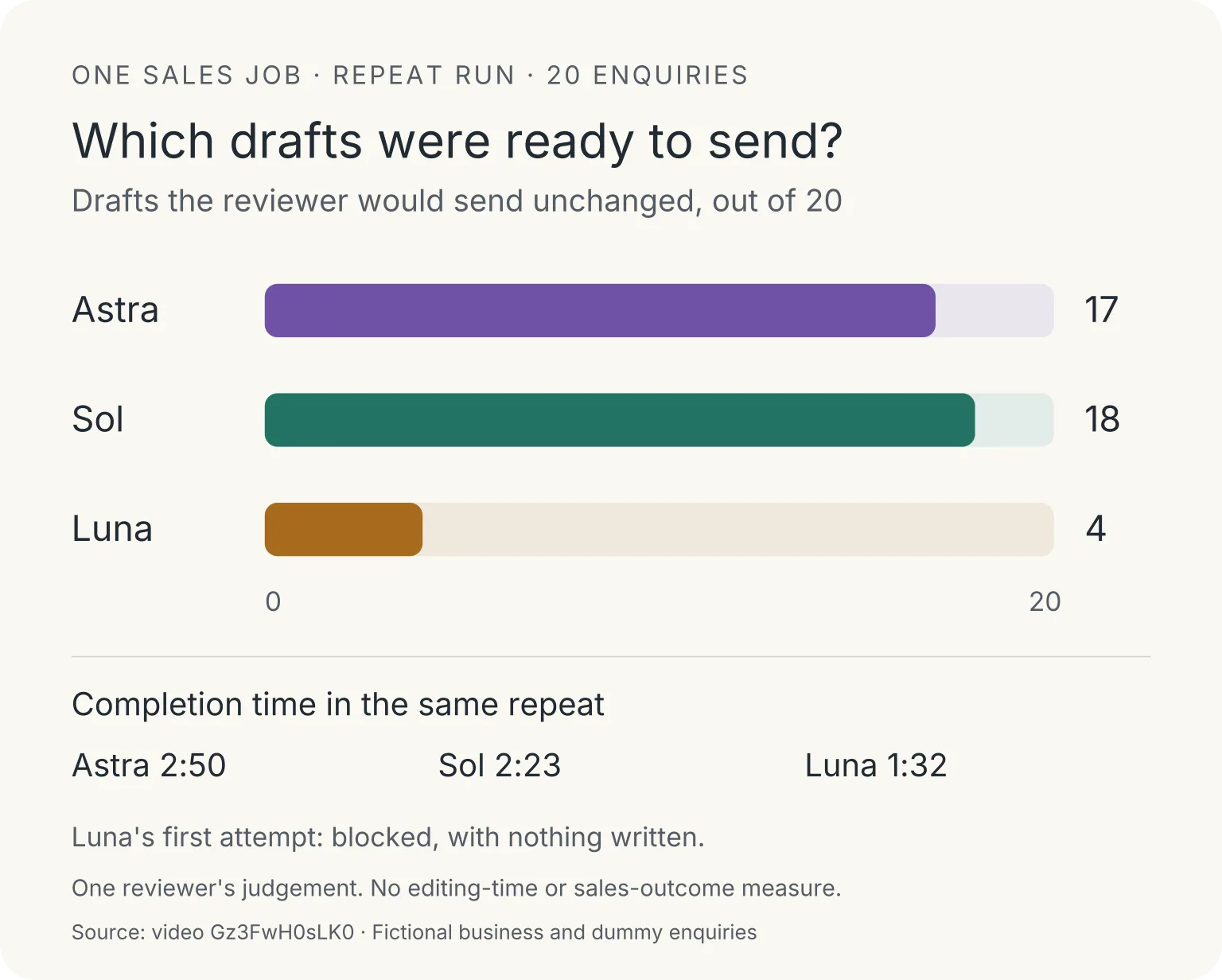
The draft check exposes a difference that the money score barely shows. Keeping money out of a reply is necessary for this brief, but it does not make the whole message ready to send.
Luna's 1:32 completion time measures how quickly it finished the agent task. It does not include a person's time correcting the remaining drafts. The video does not report that editing time, so there is no basis for claiming an overall time saving or calculating a cost per usable reply.
Likewise, eighteen accepted drafts are not eighteen delivered emails or eighteen bookings. This test evaluates preparation work. Sending, delivery and sales outcomes would need their own records.
Choose a model for the job you have
For recurring work like this batch of enquiries, the video's recommendation is Sol. The reported results support trying it first on a similar draft-only workflow: it completes both attempts faster than Astra and matches it on the two explicit rule checks.
The difference in unchanged drafts is small between those two candidates: eighteen versus seventeen in the repeat. With only twenty enquiries, that is a reason to test on your own messages, not a promise that Sol will always write better replies.
The presenter also says Astra has worked better for complex, multi-step flows in their experience. This sales task does not test that claim. If your employee has to reconcile several systems or handle a longer sequence of dependent actions, build an evaluation that includes that work.
Luna's completed run suggests a candidate worth testing where speed matters and every draft is checked. Its blocked first attempt and low unchanged-draft count make unattended customer replies a poor conclusion to draw from this video.
Keep the surrounding operating process in view whichever model you choose. KyoubeAI is an AI operating system for organisations where people and AI employees share tasks, company data and apps. It gives the sales assignment and its output a shared place to inspect. The model still has to earn its role through the work it produces.
Try the comparison on your own workflow
Choose a small batch of fictional or appropriately de-identified enquiries. Write the expected ratings and reply rules before running the agents, including how to mark incomplete requests. Keep the model as the only intended difference between candidates and record the settings you use.
Repeat with fresh agents and records. Preserve blocked attempts alongside completions, and have a reviewer inspect the drafts without seeing the candidate names. Measure editing time if you want to compare the full workload. Leave sending disabled while you evaluate the messages.
Watch the short comparison below to see how the catering test is set up and how the results are judged.
Playing loads YouTube, which may use cookies and collect viewing data. You can also watch on YouTube.
Then start with KyoubeAI and give your first sales employee one batch to rate and draft. Keep the original enquiries, the answer key and the review decisions together so the next model comparison can use the same evidence.
This guide sets up one part of the Sales Supercube, which shows the whole function running on KyoubeAI.