Suppose an AI agent changes supplier record 4417. Your finance lead wants to know who authorised the change, which instruction the agent followed and what else it could access. Running the model on your own server answers none of those questions by itself.
AI sovereignty means having effective control over the AI your organisation depends on. For a company putting agents to work, that control has to include their identity, permissions and operating record, alongside the model and the infrastructure. Otherwise you can own the hardware and still struggle to explain what happened on it.

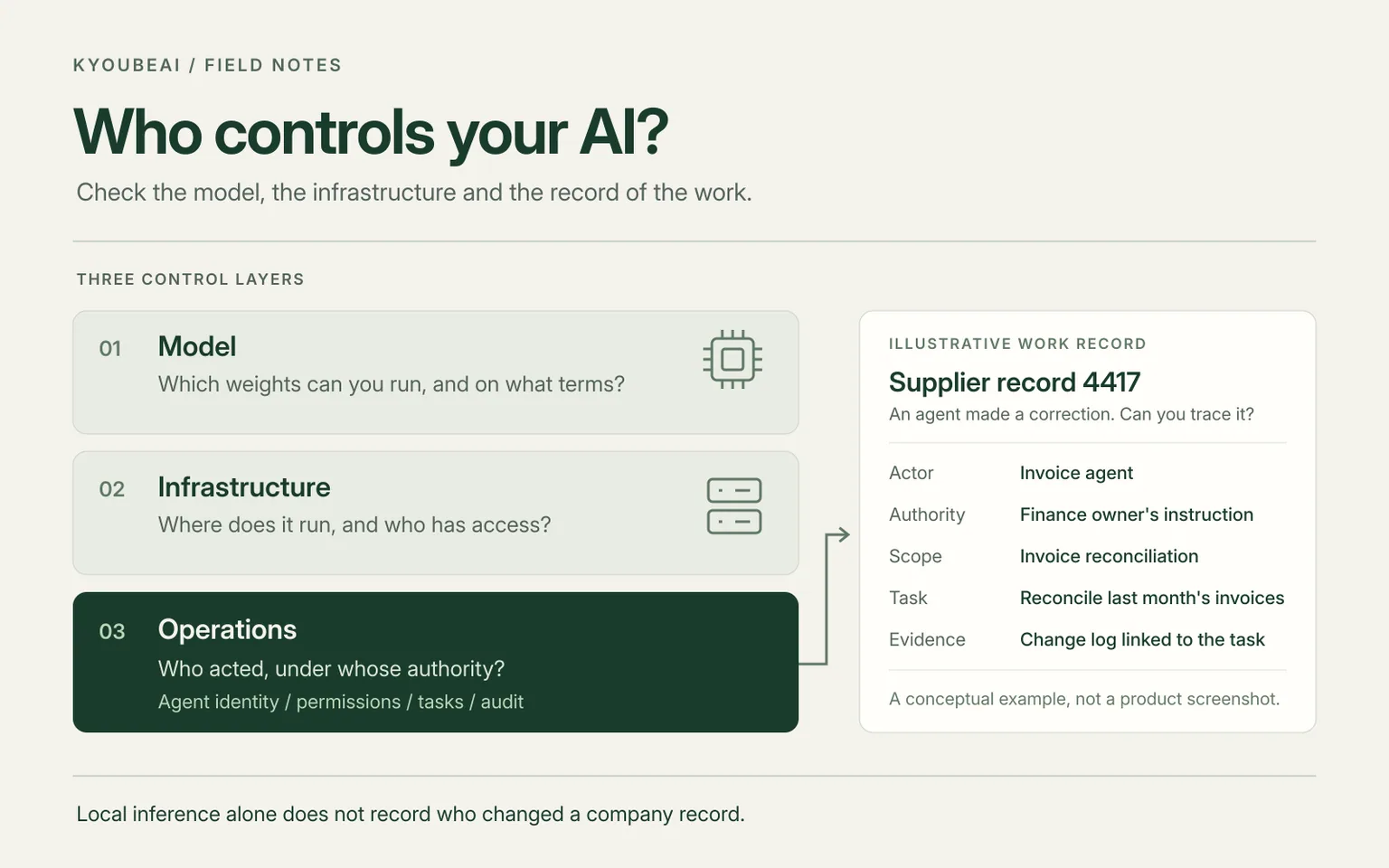
What AI sovereignty means for an organisation
A useful sovereignty question names a dependency and asks who can change it. Can a provider withdraw the model you use? Who can access the infrastructure? Can you recover the records of an agent's work if you leave the service that stores them?
We use three layers in this note. They are a practical way to inspect a deployment, not a legal classification.
Model sovereignty concerns the weights you run and the terms under which you can use them. Downloadable weights give you an option to operate a model yourself, subject to its licence and the resources it needs. Access through a hosted API leaves you dependent on that provider for inference.
Infrastructure sovereignty concerns where inference, company data and supporting services run, who operates them and which jurisdictions apply. A local database and a remote model API are two separate infrastructure decisions. A diagram that shows only the database leaves out where the prompts go.
Operational sovereignty concerns the agents doing the work. It asks who each agent is, what it may touch, who assigned its task and where the evidence of its actions lives. That evidence needs to remain accessible to the organisation after the session ends.
Each layer can fail independently. A local model can act through a shared account with no useful attribution. A well-governed agent can send confidential context to an unsuitable model provider. You need to inspect the whole path.
Open weights and sovereign infrastructure give you real options
There are concrete choices at the model layer. Mistral Small 3.1 was released under Apache 2.0, with downloadable base and instruct checkpoints. That gives an organisation a model it can evaluate for a deployment it operates itself. Whether it meets the job's accuracy and performance requirements still needs testing; the licence does not answer that question.
There are choices at the infrastructure layer too. AWS announced general availability of its European Sovereign Cloud on 15 January 2026, with its first region in Brandenburg, Germany. AWS describes it as physically and logically separate from its other regions, operated exclusively by EU residents, with customer-created metadata kept in the EU. Those are AWS's stated properties, not an independent legal assessment by us.
A managed service deserves consideration when the team cannot safely operate the infrastructure itself. Self-hosting transfers responsibility for maintenance and recovery to you. Neither choice removes the need to check the provider's terms, access arrangements and the rest of the deployment.
These options address important dependencies. They cannot supply the missing instruction or identify an agent that used somebody else's login. Your application has to preserve those records.
Follow one invoice correction through the system
Consider a hypothetical agent asked to reconcile last month's supplier invoices against purchase orders and correct the mismatches. It runs in a harness on a finance employee's laptop, calls a model API and uses the employee's finance-system credentials. The employee gives the instruction in chat. The agent makes the corrections and replies there with a summary.
That can be enough to finish the job. Now suppose supplier record 4417 contains the wrong value, and a colleague has to investigate.
The finance system's audit log attributes the update to the employee's credentials. The chat holds the request, if it has been retained. The laptop holds the agent's instructions, which may have changed since the run. The summary says the reconciliation finished, but may not link each correction to the task that authorised it.
There are records, but they answer different questions:
| Question | Where the answer would have to come from |
|---|---|
| Which agent acted? | An agent identity connected to the external call; a borrowed human login is insufficient. |
| Who authorised this job? | The retained assignment and any approval required for the correction. |
| What instruction did it follow? | The task and the version of the instructions used during the run. |
| What could it access? | The permissions and credentials effective at that time. |
| What changed? | The destination system's change record, correlated with the agent's run and task. |
Move this example to an open-weight model on hardware you own. The inference dependency changes. The attribution problem stays until you change how the agent is identified and how its work is recorded.
There is also a practical limit to a central task tracker: it cannot invent evidence the destination system never recorded. If a finance SaaS accepts only a shared credential, you need a supported service identity or an integration that preserves attribution. Writing an agent's name in a task summary does not change the identity in the SaaS audit log.
Why the operating record matters
The record is useful while the company is running normally. A colleague needs to distinguish an authorised correction from an agent doing work outside its brief. After an error, the team needs to find the affected records and decide what to repair. When access changes, someone needs to know which agents still depend on that credential.
It also matters when you change providers. Keeping the model's weights will not help you migrate a task history trapped in another service. An export needs enough context to connect the assignment to the actor and the result. Test whether you can restore and use it, rather than treating the existence of an export button as proof.
Audit has limits. A log that records an actor and affected record IDs may tell you where to investigate without preserving the previous values. If your recovery plan needs those values, arrange that separately through backups or the destination system's history. Store only the sensitive data you need, with a retention policy suited to the work.
These are operational reasons to keep evidence. They do not establish that a particular deployment meets a regulatory requirement.
Six questions to ask about one working agent
Pick an agent that already touches company data. Try to answer these questions using its actual records.
- Does it have its own identity, and can you connect that identity to the accounts used in external systems?
- Can you identify the permissions effective during a particular run, including the external credentials it used?
- Can a colleague find the task, the person who assigned it and the instruction the agent received?
- Can you recover the version of its standing instructions used for that task?
- Can you trace one change from the task to the agent's run and the destination system's log?
- Can you export and restore the evidence you need without depending on a live session or somebody's laptop?
Do this with one specific change, not a demonstration task. If a link is missing, name the system that should supply it. You may need to fix an integration or a retention setting; you may need to give the agent a separate account. Buying a different model will not fill those gaps.
What KyoubeAI supplies, and where the boundary is
KyoubeAI is an AI operating system for organisations that you run on your own server. Agents have roles, instructions, budgets and reporting lines. Their work is assigned as tasks with owners, so the assignment and output have a place in the company's records.
Its data-access levels are none, read, write and schema, granted per agent. For calls through the MCP gateway, tool profiles control which tools an agent can see, and policies control whether a particular call is allowed or requires human approval. Attempts through that gateway are audited, including denied calls and calls sent to approval.
The route matters. The same governance documentation states that Kyoube Data REST calls are checked by the data-access grant, without the MCP profile and policy layer. A destructive-call approval configured on the gateway should not be mistaken for protection on every possible route. Grant schema access only where the responsibility justifies it.
The security documentation describes a separate Postgres schema and role for each company's Kyoube Data. Schema and row mutations write an audit entry in the same transaction as the change. Those entries contain the actor, operation and identifying metadata, not row contents. That is evidence of the mutation, not a complete copy of the data before and after it.
KyoubeAI also documents an external dependency: authenticated harnesses talk to their model providers by design. Self-hosting the workspace does not make those calls local. You still need to decide which context may leave the deployment and whether a provider is appropriate for it. External SaaS attribution and retention also need their own checks.
This is where an AI OS helps with sovereignty: it gives agent identity, assigned work and local data governance a shared home. The organisation still owns the work of configuring access, protecting backups and connecting that evidence to systems outside it.
Before widening an agent's access, choose one change it made and follow it back to the assignment. Verify the external account, the permissions and the audit record, then export the evidence and check that you can use it. That exercise will tell you which part of your AI you control and which dependency needs attention next.