
Product management decides what a company builds next and why. It starts with listening: support tickets, sales calls and usage data. Then someone sizes up the options, picks one and writes down what to build, who it is for and how the team will know it worked. Engineers build it, marketing launches it, and someone checks whether it moved the goal.
Small companies often skip most of that. The founder decides and the feedback sits in an inbox. As AI coding tools make building faster, knowing what to build becomes the slow part. That research and writing is work you can hand to AI employees, provided every decision about what gets built, priced or promised still comes back to a person.
This guide walks through a complete setup in the order we built it. The example is Kyoube Industrial Systems, a fictional company that sells software to mid-size factories. It has about 140 customers, 60 staff and three products: Kyoube Pulse warns before a machine fails, Kyoube Line is a live production-line dashboard and Kyoube Field is a mobile app for technicians. Engineering stays human. Product management is run by 32 AI employees in KyoubeAI.
They finished 53 tasks. Using per-task estimates set before any run, the accepted work would have taken a person about 134 hours. The agents' own runtime was a little over three hours. Those figures come from one fictional company with dummy data, so treat them as a description of this setup, not a benchmark.
Hire one product leader and have it design the process
Start with one AI employee: a chief product officer (CPO). In this setup it runs on Claude Code with Opus 5.5. Its first task is to design the process, not to hire anyone. Ask for a product playbook built from best practice and fitted to the company.
Kyoube Industrial Systems was starting Q1 planning with four pressing problems. Harrowgate Packaging, the largest customer, wanted a custom feature and its renewal depended on it. Kyoube Line was losing small customers. Technicians wanted Kyoube Field to work offline because factory Wi-Fi is poor. And a competitor, Vantor Systems, had just launched AI failure prediction.
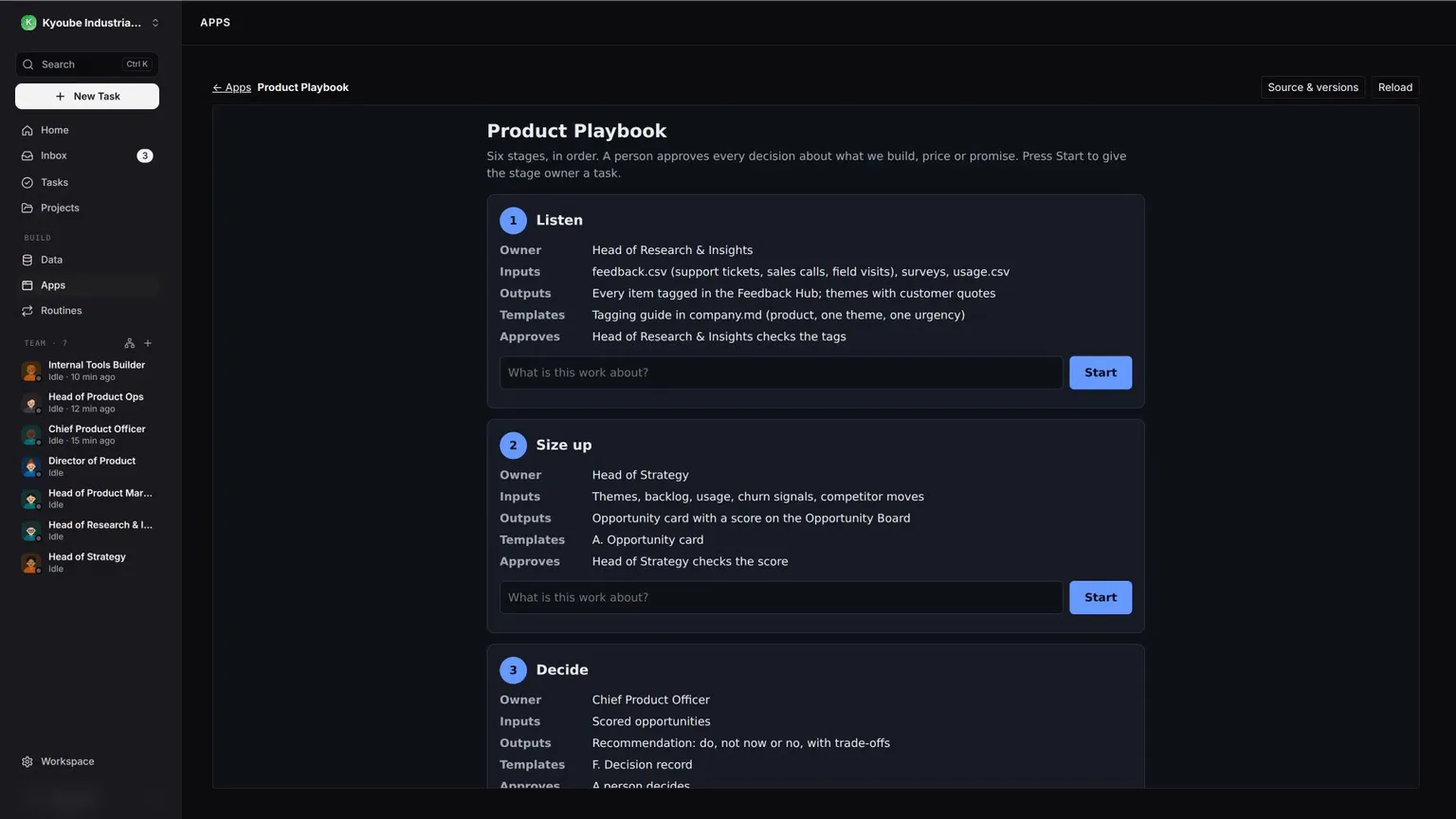
The CPO's playbook has six stages. Every stage has an owner, inputs, outputs and a template:
| Stage | Owner | Output | Who approves |
|---|---|---|---|
| Listen | Head of Research & Insights | Every feedback item tagged, with themes and customer quotes | The head checks the tags |
| Size up | Head of Strategy | A scored opportunity card on the Opportunity Board | The head checks the score |
| Decide | Chief Product Officer | A recommendation: do, not now or no, with trade-offs | A person decides |
| Define | Director of Product | A PRD, user stories and a prototype if the flow is new | A person signs off the PRD |
| Build and launch | Head of Product Marketing | Release, launch checklist, release notes and sales note | A person gives the go or no-go |
| Learn | Head of Product Ops | A readout: did it move the goal? Ship, change or drop | A person decides |
The templates cover an opportunity card, a product requirements document (PRD), user stories, an experiment readout, a launch checklist and a decision record. The playbook also marks four points where a person must approve: the PRD sign-off, the custom-feature decision, the Q1 plan and the launch go/no-go.
The ground rules at the top are worth copying into any AI product team:
- People decide. A person decides what gets built, priced or promised to a customer.
- No made-up numbers. Every number names its source. If there is no number, the agent writes "unknown" and says how it would get one.
- One owner per piece of work. Every task has one owner, who finishes it end to end.
- Review once, up the line. The owner's manager checks the work once before it reaches a person.
- Goals first. Every opportunity, PRD and roadmap item names the company goal it serves.
The playbook arrives as an approval card and a person approves it. Writing the process before hiring anyone else matters because the process tells you which roles you need.
Give the company product management skills
A skill is a how-to file an agent loads when a task needs it: a SKILL.md file, sometimes with templates. A plugin is a bundle of skills. You can write your own or import them from GitHub. Several open-source product management collections are useful starting points:
| Repository | What it offers | Licence |
|---|---|---|
| phuryn/pm-skills | Product skills and plugins from discovery to go-to-market | MIT |
| anthropics/knowledge-work-plugins | Includes a product management plugin | Apache 2.0 |
| deanpeters/Product-Manager-Skills | A product management skills framework | CC BY-NC-SA 4.0, non-commercial |
| anthropics/skills | Skills for Word, Excel, PowerPoint and PDF output, and for writing your own | See the repository |
Check each licence against how you will use it. The third collection is non-commercial, so a company should read it for ideas rather than import it.
Read every skill file before importing it. The files used here were plain text with no scripts. Importing the first two collections gave Kyoube Industrial Systems 70 skills. The CPO then added a skills-by-role table to the playbook: it mapped 41 of the 70 skills to the 32 roles, with at most three per role, and explained why it left the rest out. Once that table is approved, every hire starts with the right skills instead of all of them.
Let the leaders hire their teams
Set one rule before hiring starts: every new hire needs a person's approval. The playbook already names five teams and the app each one owns:
| Team | Head | Owns |
|---|---|---|
| Strategy | Head of Strategy | Opportunity Board |
| Research & Insights | Head of Research & Insights | Feedback Hub |
| Product | Director of Product | Roadmap and Project Board |
| Product Ops | Head of Product Ops | Agent Scorecard |
| Product Marketing | Head of Product Marketing | Launch Tracker |
The CPO writes a hiring request for each head with its role, model and skills from the table. Each request arrives as a card and is approved one at a time. The heads then hire their own teams, and the three product leads and the analytics lead hire theirs. A person made one hire directly. The agents requested the other 31, and a person approved each one. The org chart ends with 32 AI employees on four levels.
Match the model to the job. Managers review and split work, so in this setup they run on Claude Code with Sonnet 5.5. Specialists do most of the volume, so they run on the faster Gemini 3.8 Flash in Antigravity.
Before any real work, check every agent's model, manager and skills. Managers can hand work only to their own reports, so a wrong reporting line breaks delegation.
Give every team an app over shared data
The Head of Product Ops hires one more agent before the rest: an internal tools builder. Its first job is the Product Playbook app shown at the top of this guide. Every stage has a Start button: type a topic, press Start and a task goes to that stage's owner.
An app that can send work to agents needs a person to publish it. In KyoubeAI the app declares task templates, and the person publishing the version reviews the list of tasks it can create before confirming. The builder also needs permission to create tables, one level above the default.
Every other app follows the same pattern: the team that owns it writes the spec and the builder builds it. Here, each app took about a minute to build.
- Feedback Hub (Research & Insights): 60 feedback items from support tickets, sales calls and field visits, filterable by product, theme and urgency.
- Opportunity Board (Strategy): every opportunity scored by reach, impact, confidence and effort, with a 40-item backlog.
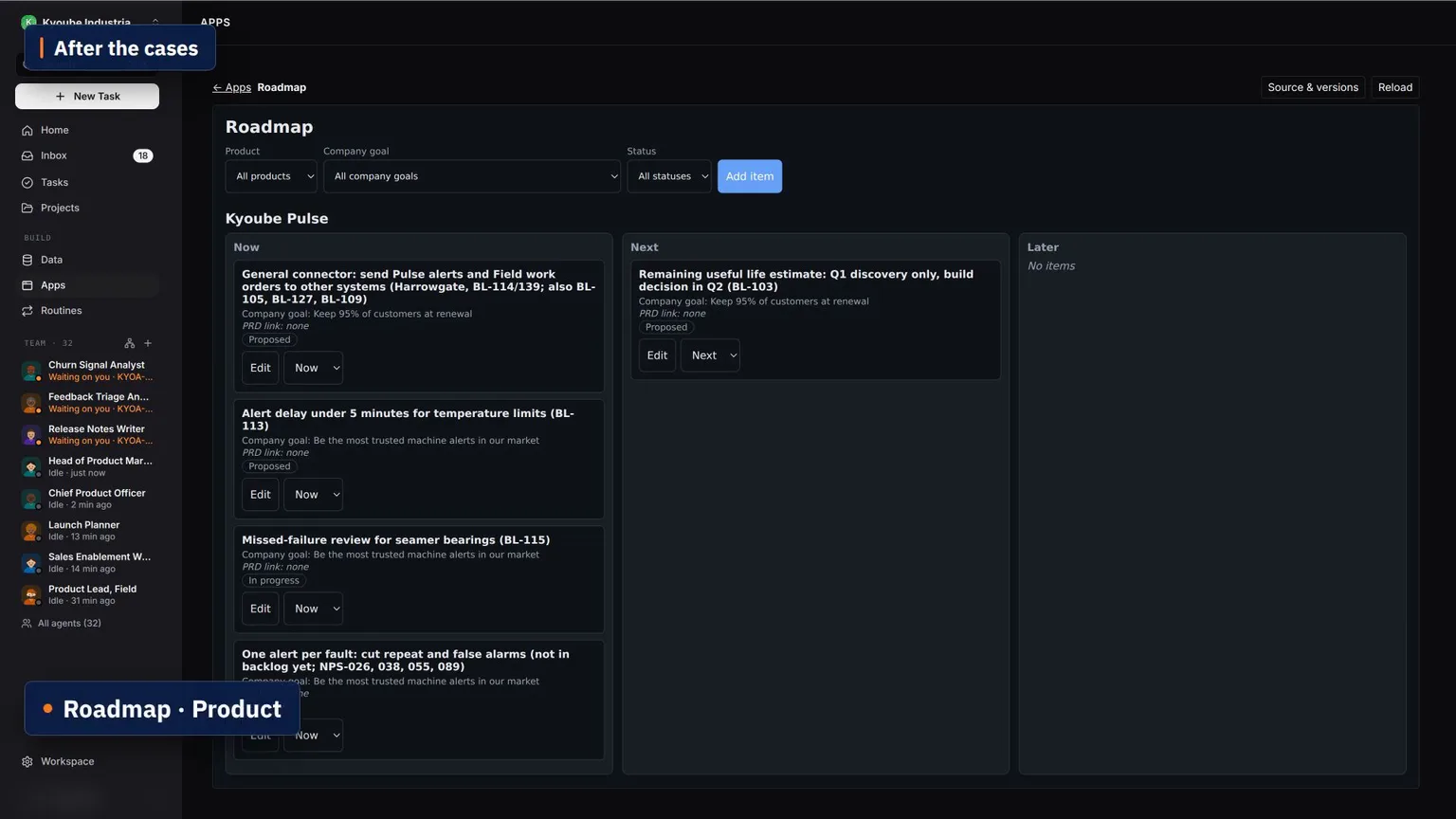
- Roadmap (Product): now, next and later for every product, with each item naming its company goal.
- Project Board (Product): the epics and stories waiting for the engineers.
- Launch Tracker (Product Marketing): every release with its checklist, notes, sales one-pager and go/no-go call.
- Agent Scorecard (Product Ops): how every AI employee is doing, in plain counts.

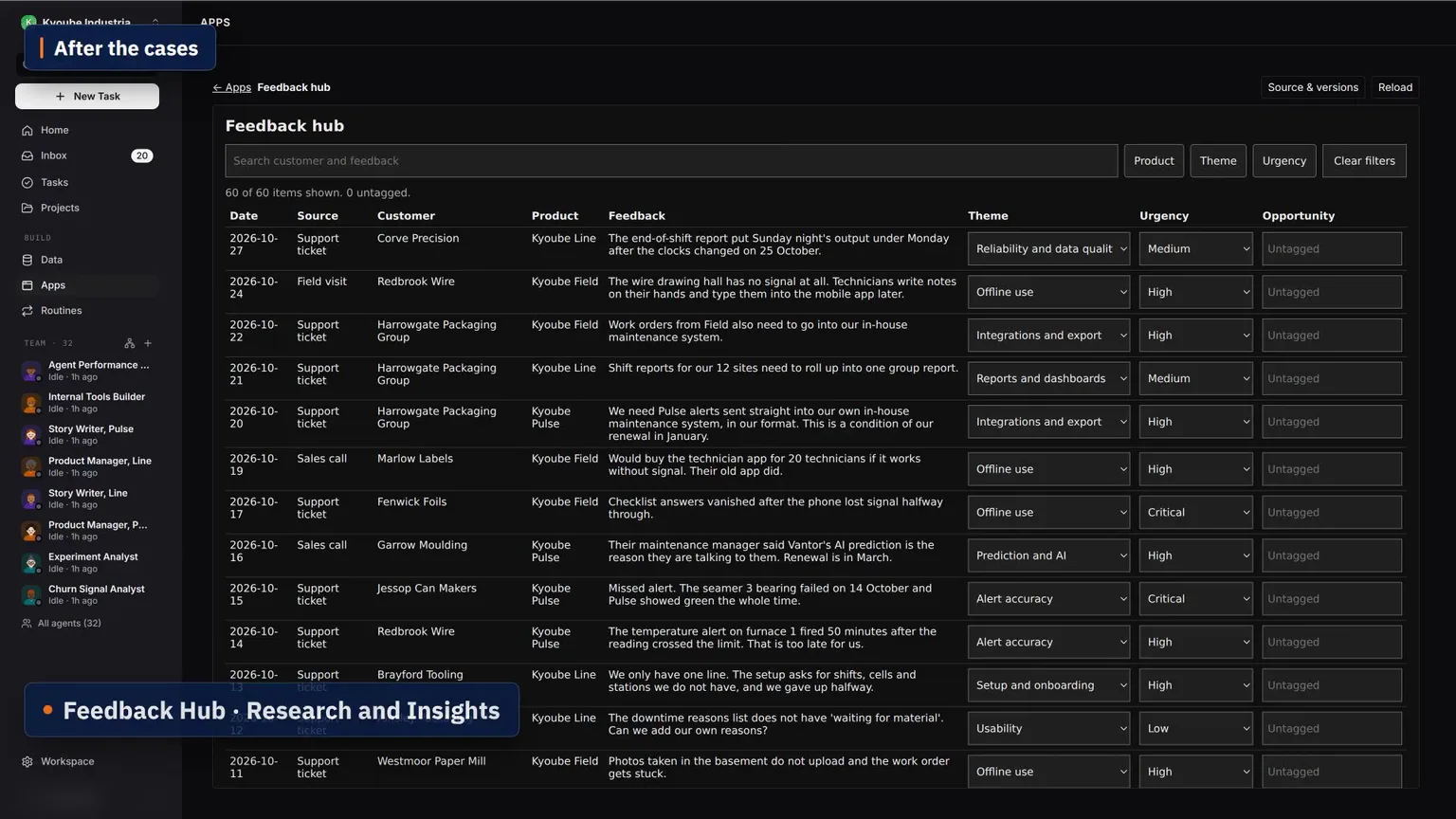
Because the apps sit over shared company Data tables, a later stage can cite the feedback item, backlog entry or experiment behind its recommendation. Read more about how Kyoube Apps work.

Run real work, from one task to a quarterly plan
Run work in increasing order of complexity. Start with direct tasks to one specialist, then give managers work they split across their teams, then run a whole stage from the playbook. Write an answer key or checklist before each run so you can judge the output.
Direct tasks to one specialist
Release notes. The release notes writer gets the six tickets that shipped in Pulse 4.2. In about three minutes it writes notes covering all six in customer language, such as "90-day vibration charts now load in under 5 seconds, where they used to take up to 40", and adds a Pulse 4.2 row to the Launch Tracker.
Feedback triage. The feedback triage analyst tags all 60 items by product, theme and urgency in about 12 minutes. Against the answer key, product is right on all 60, theme on 50 and urgency on 49. Forty items are right on all three. That is a useful first pass, and a reason to keep a person checking theme and urgency.
Churn signals. The churn signal analyst works out which Kyoube Line customers dropped their usage last month and what they told support. It finds all six customers on the answer key, but also lists 16 customers whose usage moved by only one to three users. After being asked to leave those out, the second version has exactly the six.
Manager-led analysis
Reading an A/B test. The analytics lead gets a finished A/B test on Line's onboarding and must recommend ship or drop. Its experiment analyst says drop. The lead disagrees. Version B converted 41.4% against 33.8% for A, 7.6 points better, but the p-value is 0.107, so the result is not proven. The test would need about 630 trials per version. The lead also spots that the first 210 trials all went to version A. Its call is to hold and rerun the test.
The answer key had said ship, ignoring significance. The lead's call was sounder, so the case was left out of the accuracy count and the test was rerun. Agents that show their reasoning can catch errors in your own assumptions.
A large customer's custom request. Harrowgate is about 11% of revenue and renews at the end of January. It wants every Pulse alert and Field work order sent into its own maintenance system, in its own format. Engineering estimates 10 to 12 weeks for one engineer, plus upkeep.
The Head of Strategy splits the work between the market and competitor analyst and the pricing and packaging analyst. It recommends a general connector instead: Harrowgate could use it, and so could the three customers asking for SAP and the one asking for MES. It adds the connector to the Opportunity Board with reach 7, impact 2, confidence 0.5 and effort 3, a score of 2.33. The decision stays with a person, who chooses the general connector.
A complete feature definition
The biggest single piece of work is offline mode for Kyoube Field. The product lead for Field splits it three ways. The product manager writes the PRD using an imported PRD skill and its eight-section format. The PRD quotes six customers, including technicians at Redbrook Wire who write notes on their hands because the wire hall has no signal. It also finds that eight of the 12 Field detractors in the survey complain about lost work or signal. The story writer turns the PRD into seven stories on the Project Board, and the prototyper builds a clickable mock-up as a small app. All of it takes about 16 minutes.

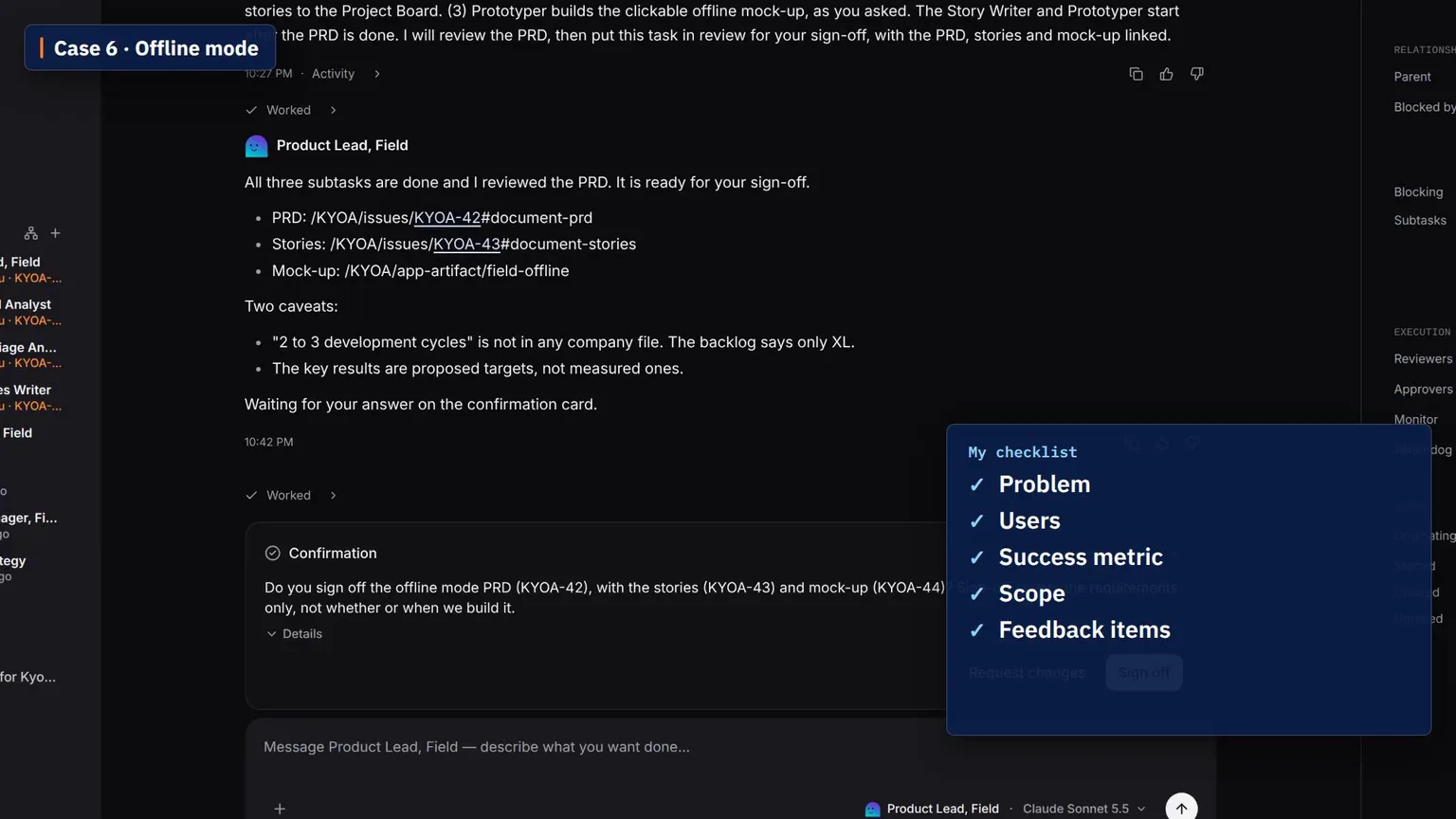
The PRD comes back with a sign-off card and is checked against a checklist: problem, users, success metric, scope and the feedback items behind it. It has all five, but no risk section. It also says "2 to 3 development cycles" with nothing to back it up, and the lead had flagged that line too. Requesting changes sends it back. About 30 seconds later the revision adds a risk section and drops the unsupported estimate, and the PRD is approved.
A quarterly plan from the playbook
This case uses the playbook as intended. On the Decide stage, the topic is the Q1 2027 plan: feedback themes, Line churn, the response to Vantor and a roadmap draft. Pressing Start sends the task to the CPO, which pulls in the earlier work: the triage, the churn list, the experiment and the custom-feature decision.
In about three minutes it writes a decision record with options. On Line churn, six of the 16 small customers lost half or more of their users in October, and their reasons match small fixes already in the backlog. On Vantor, three customers raised it, but the company's own customers complained more about false and late alerts. The CPO recommends option A, trust and retention first: fix alert trust now, run discovery on failure prediction in Q1 and decide on a build in Q2. It also fills the Roadmap with 18 items across the three products, each linked to a company goal.

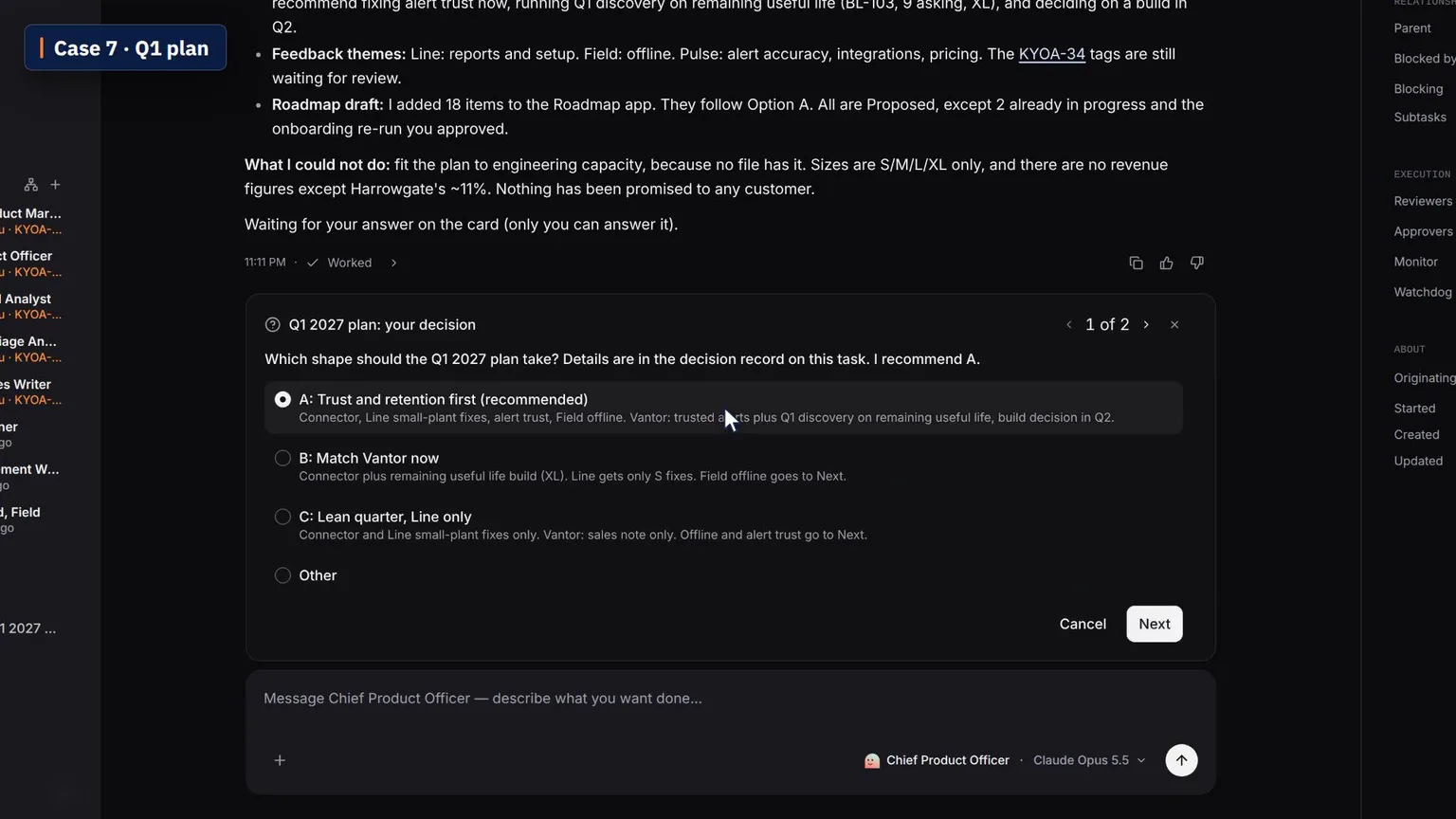
Notice what the CPO says it could not do: it could not fit the plan to engineering capacity, because no file has it. That is the "no made-up numbers" rule working. A person picks option A.
A launch
For the Pulse 4.2 launch, the Head of Product Marketing asks the launch planner for a checklist and the sales enablement writer for a one-pager. Before either reaches a person, the head checks the sales sheet against the ticket and feedback files. It removes a claim about contract terms that no company file supports, drops "one-click" and "fast" because the tickets do not support them, and ties a customer point to the feedback it came from.
Both documents land in the Launch Tracker beside the release notes. The checklist has five items, including a support briefing and a customer email. A person makes the go call.
Score every output against a checklist you wrote first
The agent performance analyst fills the Agent Scorecard from the platform's task records. Besides the cases above, every other agent completed at least one real task, so all 32 rows come from actual work.

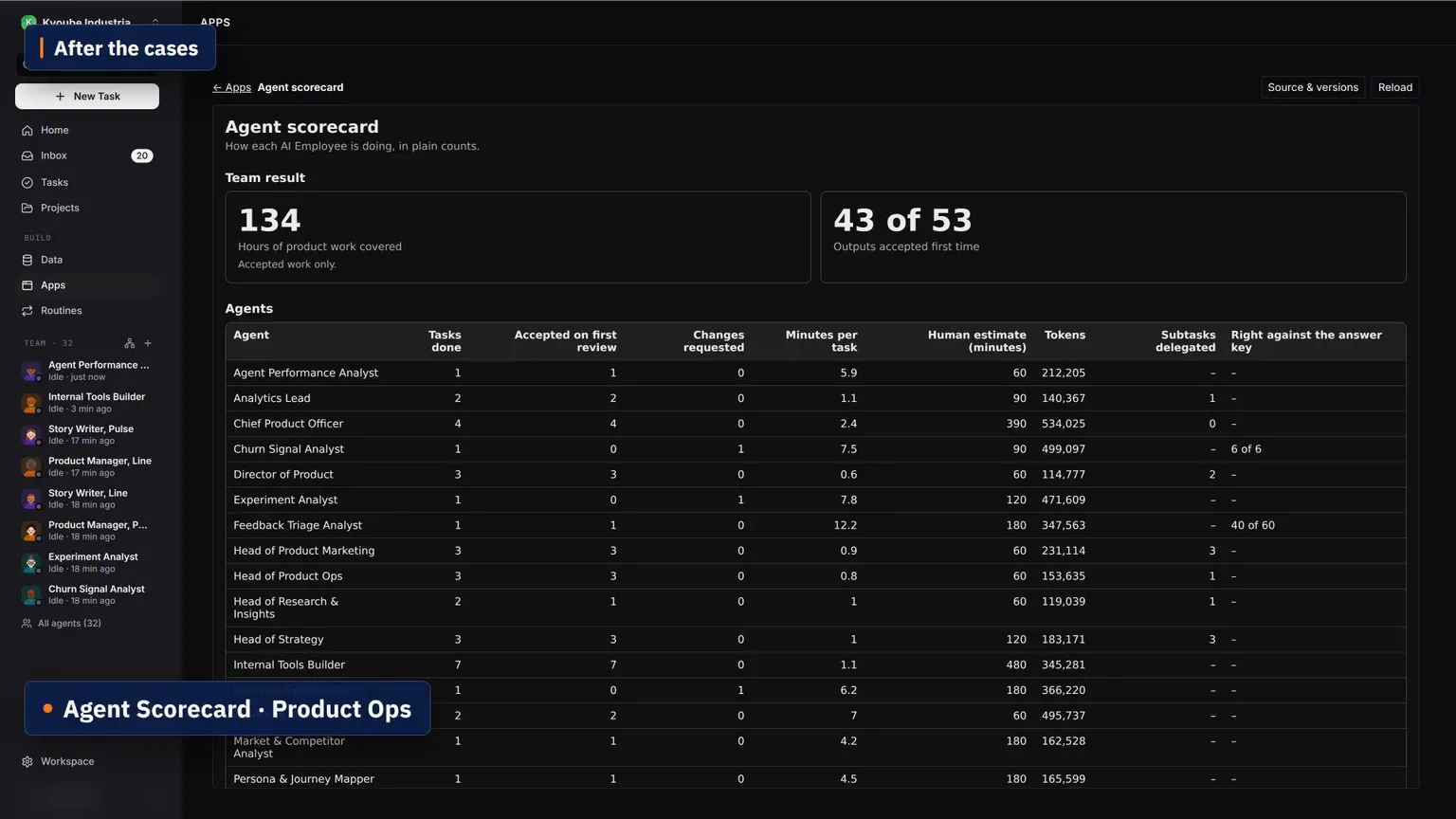
Every output was reviewed against the checklist written before the runs:
| Measure | Result |
|---|---|
| Outputs completed | 53 |
| Accepted first time | 43 |
| Returned with one change request | 9, all fixed on the next version |
| Manager tasks accepted first time | All but one |
| Apps built by the internal tools builder | 7, all accepted |
| Estimated human time for accepted work | About 134 hours |
| Agent runtime across all 53 tasks | A little over 3 hours |
All nine returns were specialist work: three PRDs, two sets of stories, the churn list, the experiment readout, a pricing note and an interview summary. Most manager tasks took about a minute of runtime, because their job is to split the work and check it.
The human-time figure is an estimate per task type, set before any run. Neither figure counts the time a person spent reviewing outputs, so the difference is not a net saving. Plan for that review time, especially on specialist work such as PRDs and analysis.
How the team works day to day
Once the setup is in place, people use it in three ways:
- Big repeating processes start from the playbook. Pick the stage, type a topic, and the right manager gets the task. That manager splits it and hands parts to its team.
- Small jobs go straight to the agent who does them, such as release notes or a churn check.
- Decisions come back to people as cards. When a plan is ready to build, the stories are waiting on the Project Board for the engineers.
To recap the setup order:
- Hire one leader first and have it design the process.
- Give the company skills before hiring the rest.
- Let the leaders hire their teams, and approve every hire.
- Have each owner spec its own apps and let one builder build them.
- Run real work, from small tasks to a whole plan, and keep the decisions with people.
- Score every output against a checklist you wrote first.
KyoubeAI is an AI operating system for organisations where people and AI employees share tasks, company data and apps. For the role and access principles behind a rollout like this, read how to implement AI in an organisation. For the same pattern applied to another function, see how to run an AI marketing team.
You do not need 32 agents on day one. Start with KyoubeAI, hire a product leader, and give it one task: write your product playbook, including where a person must approve.